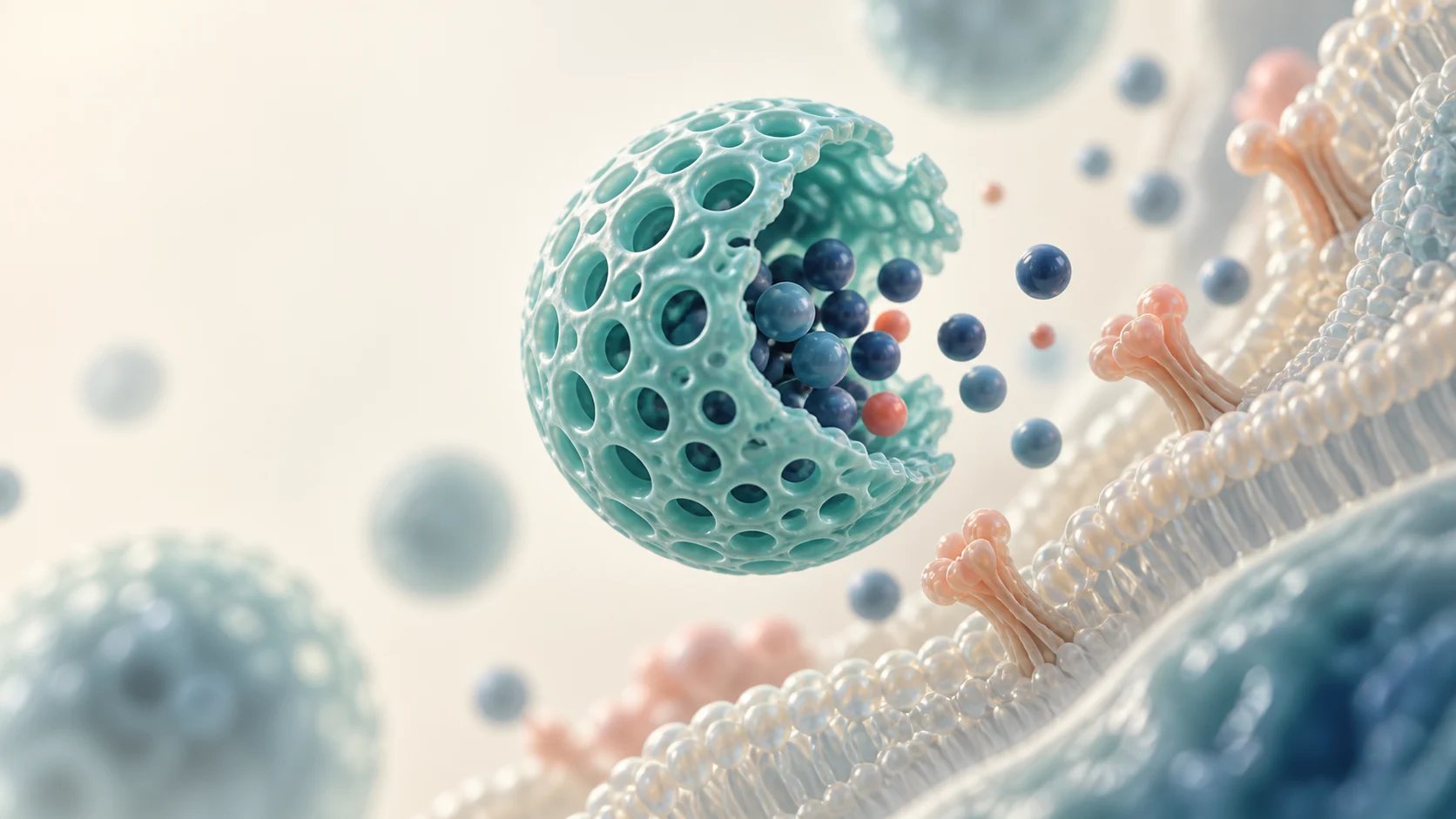
Collaborative preclinical studies connecting delivery, catalysis and biological response in antibacterial activity, inflammation, imaging and tumor immunity.
The research question
Composition, surface properties and local responsiveness influence payload release, reactive oxygen species and cellular signaling. The collaborative studies examine oral antibacterial activity, oxidative stress in inflammation, tumor imaging and radio-immunotherapy. The work described here concerns materials and preclinical models, with findings interpreted within each study’s experimental conditions.
Research approach
Design delivery systems around payloads, degradability and responsiveness.
Connect material behavior with cellular and immune mechanisms.
Evaluate in preclinical models, including cells and animals.
Materials and methods
Delivery and responsiveness: biodegradable nanocarriers, liposomes and engineered bacterial outer membrane vesicles.
Catalysis and regulation: Prussian-blue nanozymes, photothermal effects, ion release and reactive oxygen species.
Imaging and mechanisms: magnetic-resonance probes, cuproptosis, cGAS–STING signaling and DNA-damage studies.
Preclinical evaluation: materials and biological responses in bacteria, biofilms, cells and animal models.
Selected publications and research notes
Functional Nanomaterials for Biomedicine · 2025
Biodegradable nano-immune agonist for enhanced immunotherapy of melanoma via the synergistic action of cuproptosis and cGAS-STING enhanced immune response
Qingdong Li, et al.
Journal of Colloid and Interface Science, 2025, 690, 137326
A collaboration with Guilong Zhang at Binzhou Medical University combines cuproptosis, cGAS–STING activation and MRI in preclinical melanoma research.
Question: How can biodegradable carriers connect cuproptosis with immune activation?
Design and findings: A collaboration with Guilong Zhang at Binzhou Medical University combines cuproptosis, cGAS–STING activation and MRI in preclinical melanoma research.
Scope: This is preclinical cell and animal research in collaboration with Guilong Zhang at Binzhou Medical University, not an approved clinical therapy.
Silver-doped Prussian blue in cationic guar gum combines near-infrared photothermal action with silver-ion release against oral pathogens and biofilms, with validation in a rat caries model.
Question: How can photothermal activity and silver-ion release be combined against oral bacteria and biofilms?
Design and findings: Silver-doped Prussian blue in cationic guar gum combines near-infrared photothermal action with silver-ion release against oral pathogens and biofilms, with validation in a rat caries model.
Scope: The antibacterial findings use the reported laser conditions and bacterial/rat models; this is preclinical research.
Porous manganese–iron Prussian blue nanozymes scavenge reactive oxygen species and are evaluated in a mouse model of acute ulcerative colitis. Batches of approximately 11 g retain activity comparable with small-scale preparations.
Question: Can scaled-up nanozyme preparation preserve antioxidant activity and effects in animal models?
Design and findings: Porous manganese–iron Prussian blue nanozymes scavenge reactive oxygen species and are evaluated in a mouse model of acute ulcerative colitis. Batches of approximately 11 g retain activity comparable with small-scale preparations.
Scope: The mouse regimen was 10 mg/kg/day for three doses. Laboratory scale-up does not imply industrial manufacture or clinical approval.
Engineered Magnetic Resonance Nanoprobes for Visualizing Tumor Programmed Cell Death Ligand 1 Level and Enhancing Synergistic Radio Immunotherapy
Xiao Sun, et al.
ACS Nano, 2025, 19(41), 36158-36170
A gadolinium-hybridized platinum nanoplatform bearing a PD-L1-antagonistic affibody combines PD-L1-targeted MRI, catalytic oxygen production and radical generation for synergistic radioimmunotherapy research.
Question: How can PD-L1-targeted imaging be linked with radiotherapy and immune modulation?
Design and findings: A gadolinium-hybridized platinum nanoplatform bearing a PD-L1-antagonistic affibody combines PD-L1-targeted MRI, catalytic oxygen production and radical generation for synergistic radioimmunotherapy research.
Scope: A collaborative preclinical study; Zhengyan Wu is the 11th of 14 authors. It is not an approved diagnostic or therapeutic technology.
Engineering bacterial outer membrane vesicles synergetically boost superactivated anti-tumor immunity induced by radiotherapy via sustained DNA damage
Guangyu Ju, et al.
Biomaterials Advances, 2026, 183, 214780
Engineered bacterial outer-membrane vesicles co-deliver Fe₃O₄ nanoparticles and the ATR inhibitor VE822. Sustained DNA damage and immune stimulation are studied as a way to strengthen radiotherapy-induced antitumor responses in mice.
Question: How can sustained DNA damage enhance radiotherapy-induced antitumor immunity?
Design and findings: Engineered bacterial outer-membrane vesicles co-deliver Fe₃O₄ nanoparticles and the ATR inhibitor VE822. Sustained DNA damage and immune stimulation are studied as a way to strengthen radiotherapy-induced antitumor responses in mice.
Scope: A collaborative cell and mouse study, without a clinical efficacy claim.